How many times do people have to tell us the same thing before something changes?
Another survey. Similar set of questions. Another report documenting challenges that people have been describing for years.
For the people answering these questions, it can begin to feel like a broken record. They explain their struggles, describe what they need and share the difficulties they face trying to make ends meet. Yet, after the conversation ends, many return to the same circumstances.
At Public Health Equity Initiative (PHEI), we believe that listening to communities must mean more than collecting responses. It must be an opportunity to understand people’s realities, recognise the barriers they face and use what we learn to inform meaningful action.
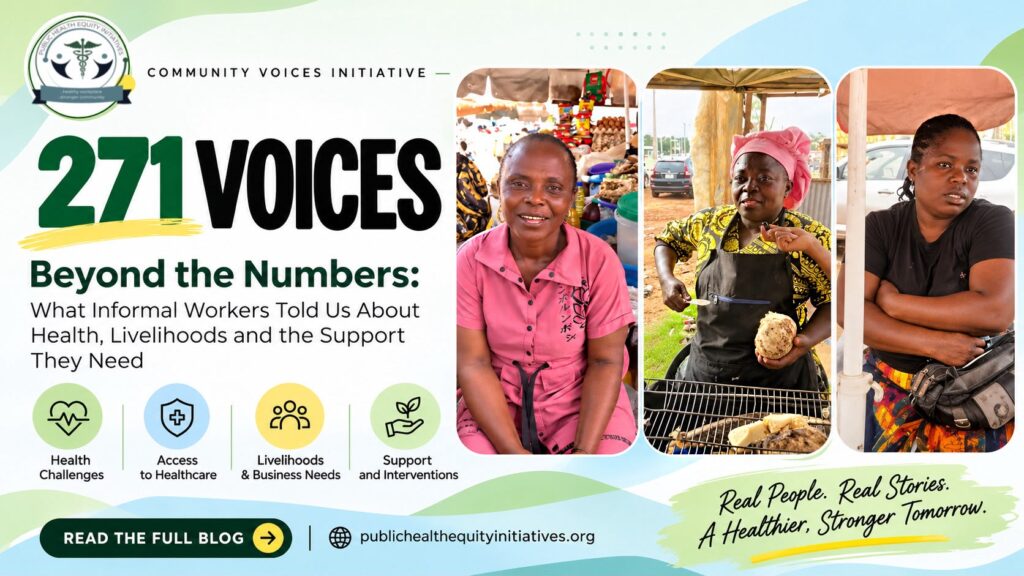
This belief informed our Community Voices Initiative and the PHEI | 271 VOICES community needs assessment. Through this initiative, we engaged 271 people working across markets, roadside businesses, workshops, other small enterprises in various community setting in Abuja Nigeria.
We wanted to understand how people earn a living, how their work affects their health, what happens when they become ill and what makes it easier or harder for them to access healthcare.
We also wanted to hear what they would like decision-makers to understand about their lives.
The findings gave us a clearer picture of the relationship between work, health, financial security and access to services. They also reinforced something important: the people whose livelihoods keep communities moving should not have to choose between earning an income and looking after their health.
But collecting these voices came with a responsibility.
Once people have trusted us with their experiences, what do we do with what they have told us?
This is the story of what we heard, what the findings revealed, the support PHEI has provided so far, the limitations we encountered and the work we hope to continue.
Why we listened to informal workers
Across markets and roadside businesses, people work long hours to sustain themselves and their families. They sell food, repair equipment, sew clothes, trade goods, provide services and build small businesses with the resources available to them.
Their work supports households and contributes to local economies. Yet the demands of earning a daily income can make looking after their health difficult.
For a person whose earnings depend on opening a stall every morning, taking a day off may mean losing income. For a trader with limited savings, an unexpected medical bill may compete with food, rent, school expenses or the cost of restocking a business.
For someone working outdoors, exposure to dust, heat, smoke or rain may be part of the working environment rather than an occasional inconvenience.
These are not simply questions of individual health behaviour. They are also questions about working conditions, financial security, the availability of services and whether existing systems work for people whose livelihoods are often informal.
We did not want to make assumptions about these experiences from a distance. We wanted to ask people directly.
The Community Voices Initiative was designed to create space for those conversations and help PHEI better understand the health and livelihood priorities within the communities we serve.
Who did we hear from?
The assessment recorded 271 in-person interviews, with consent recorded for all participants in the dataset.
The respondents represented different ages, occupations and lengths of experience.
Women accounted for 197 respondents (72.7%), while 73 (26.9%) were men. One respondent preferred not to disclose their gender.
Young and working-age adults featured prominently. People aged 25–34 accounted for 125 respondents (46.1%), while 57 (21.0%) were aged 35–44. Together, those aged 25–44 made up 67.2% of the respondents.
The occupations recorded included small business owners, petty traders, street vendors, food sellers, market stallholders, tailors, fashion designers, hairdressers, barbers, mechanics and other artisans and service providers.
Many had been doing their work for years. A total of 137 respondents (50.6%) reported between one and five years in their current work, while 111 (40.9%) reported six or more years. Twenty-two (8.1%) had been doing their work for more than 20 years.
These figures remind us that informal work is not merely a temporary activity for many people. It can be a long-term livelihood, built through experience, perseverance and years of effort.
For some, the business they operate is the main source of household income. For others, it is the product of learning a trade, developing a customer base and trying to build something more secure for the future.
Their experiences deserve to be understood in that context.
Behind every response was a person with a life beyond the questionnaire. The statistics helped us recognise patterns, but the individual experiences helped us understand why those patterns matter.
What the assessment revealed about health and work
One of the clearest findings was the frequency of reported work-related stress and physical discomfort.
Reported concern | Number of respondents | Percentage of all respondents |
Stress | 116 | 42.8% |
Back pain | 79 | 29.2% |
Body pain | 79 | 29.2% |
Fatigue or exhaustion | 38 | 14.0% |
Headaches | 26 | 9.6% |
Eye strain | 23 | 8.5% |
High blood pressure | 17 | 6.3% |
Other concerns included joint pain, smoke exposure, heat exposure, poor sanitation conditions, long working hours and various other health challenges.
These findings reflect different experiences rather than one single health problem. They also show why workplace health conversations need to extend beyond visible injuries or emergencies.
Consider someone who stands for most of the working day and repeatedly experiences leg or back pain. Consider a worker who operates around smoke, dust or heat, or a trader whose work involves lifting and carrying heavy goods. Consider a person who finishes each day exhausted but has little opportunity to rest because the next day’s income depends on returning to work.
These are illustrative examples of the types of situations represented in the assessment, not direct quotations from individual participants.
For these workers, health and livelihood are closely connected. Physical discomfort can affect the ability to work, while the need to continue earning can make it difficult to pause, seek care or change working conditions.
Mental wellbeing matters too. The 116 reports of stress are a reminder that the pressures associated with work deserve attention alongside physical health.
We should not assume that every participant experienced the same causes or consequences. However, the pattern of reported concerns gives PHEI a reason to keep workplace health, mental wellbeing, prevention and access to appropriate care on the agenda.
Healthcare access: is a service truly accessible if people cannot afford to use it?
When asked whether healthcare services were available near their workplace or home, 173 respondents (63.8%) answered yes. Ninety-five (35.1%) answered no, while three (1.1%) were unsure.
At first glance, the fact that almost two-thirds reported nearby access might appear encouraging. But physical proximity is only one part of the picture.
A healthcare facility may exist nearby, yet the cost of consultation, investigations, medication or transport can still make care difficult to afford. A worker may know where to go but struggle to find time away from work. Someone may be able to reach a facility but worry about losing the income needed to meet household expenses.
Among the recorded barrier responses:
Healthcare being too expensive was mentioned 93 times.
Distance to a health facility was mentioned 48 times.
Lack of time due to work was mentioned 34 times.
Lack of transport was mentioned 21 times.
These are recorded mentions in the dataset, not mutually exclusive categories that can be added together to calculate the proportion of all respondents affected.
Nevertheless, they point to a practical issue: healthcare access is not simply about whether a service exists. It is also about whether people can afford it, reach it and use it without placing additional pressure on their livelihoods.
For a trader, leaving a stall unattended may mean lost sales. For a small business owner, closing for an appointment may mean missing customers. For someone with limited savings, seeking care may involve weighing a health concern against immediate financial needs.
These examples help explain the significance of the barriers recorded. They do not mean that every participant made the same choices or faced the same circumstances.
The wider lesson is that healthcare services need to be accessible in ways that reflect people’s everyday realities.
The health insurance gap
One of the most striking findings concerned health insurance.
232 of the 271 respondents (85.6%) reported that they did not have health insurance. Only 37 (13.7%) reported having insurance, while two (0.7%) were unsure.
Without coverage, people may have to meet healthcare costs directly from their earnings or savings. For someone whose income is uncertain, even an unexpected health expense can create difficult choices.
Insurance alone is not a complete solution. Coverage must be affordable, understood by members, usable at appropriate facilities and suited to their healthcare needs. People also need clear information about enrolment, benefits, exclusions and how to access services.
Nevertheless, this finding identified an important area for further engagement: helping informal workers understand available health coverage and exploring practical ways to improve their access to it.
It has also informed PHEI’s direct support efforts, including assistance connected to health insurance for some of the people we have supported.
We recognise that the scale of need extends beyond the individuals we have been able to assist so far. The findings therefore provide a basis for continued community engagement, partnerships and advocacy around affordable healthcare and health coverage.
Where do people turn when they become ill?
The assessment also asked respondents what they usually did first when they became sick.
The most frequently recorded response was visiting a pharmacy, reported by 152 respondents (56.1%). Fifty-eight (21.4%) said they first visited a hospital or clinic. Twenty-eight (10.3%) reported buying medicine without a prescription, 16 (5.9%) reported using traditional or herbal remedies, and seven (2.6%) said they did nothing and continued working.
These responses describe reported first actions. They do not establish whether a person’s subsequent care was appropriate or whether they eventually visited a health facility.
They do, however, raise important questions about how people make healthcare decisions.
For some, a pharmacy may feel more convenient or affordable for a minor illness. Others may be trying to avoid the expense or time involved in visiting a hospital. Some may delay seeking care because they believe their symptoms will pass, while others may not know when a symptom requires professional assessment.
We should not assume that every person who visits a pharmacy is avoiding necessary care. Nor should we assume that every person who delays treatment does so because of a lack of awareness. The reasons differ, and they need to be understood rather than guessed.
What the findings reinforce is the importance of accessible health information, preventive care, appropriate referrals and clear guidance on when to seek professional medical attention.
They also remind us that health education works best when it acknowledges the constraints people face. Telling someone to seek care is only part of the response if cost, transport, time or availability continues to stand in the way.
Health and livelihood cannot be treated as separate issues
One of the most important lessons from the assessment is that health challenges cannot always be separated from economic challenges.
Participants described work-related pain, fatigue, stress, environmental exposure and the cost of healthcare. Some also raised difficulties sustaining or expanding their businesses, unstable income and limited access to capital.
For a small business owner, livelihood support may help strengthen the business that pays for food, housing and other daily needs. For a worker who lacks health insurance, assistance with access to coverage may help address one barrier to obtaining healthcare. For someone experiencing persistent symptoms, information about appropriate care or a referral may be more immediately relevant.
The needs are not identical, and neither should the response be.
A person who is financially stable and does not identify a need for direct assistance may benefit more from health information or preventive support. Another person may face a combination of health and financial difficulties that requires a more tailored response.
This is why a community needs assessment is valuable. It helps us move beyond assuming that everyone needs the same intervention.
It also challenges us to look at the conditions in which people work and live, not only the health concerns they report.
If a person continues to work in an environment that exposes them to dust, smoke, heat or unsafe conditions, individual advice may be helpful but may not address the full problem. If healthcare is unaffordable, awareness alone cannot remove the financial barrier. If a business has limited capital, health education may not resolve the immediate pressure affecting the person’s livelihood.
A meaningful response requires us to consider these issues together.
From listening to action: what PHEI has done so far
Collecting information was never intended to be the end of this initiative.
As we reviewed the responses, it became clear that participants had different needs and that some required more than information or general advice.
The field assessment identified 146 respondents (53.9%) as potential candidates for support, referral, training or another intervention. This reflects needs identified during data collection. It does not mean that all 146 people received support or that every person required the same type of assistance.
PHEI has since provided targeted support to some ndividuals, including business-related support and assistance connected to health insurance.
These interventions represent a beginning, not a claim that the wider needs identified through the assessment have been resolved.
For some individuals, support has focused on their livelihood and business needs. For others, health insurance-related assistance has been part of the response. The intention is to respond to identified needs in a practical way, recognising that improving someone’s ability to sustain their livelihood and improving their access to healthcare can be closely related.
We also recognise that not every respondent required individual assistance. Some did not report significant current health challenges or barriers, while others may benefit more from information, prevention or broader improvements to services and working conditions.
The aim is not to distribute assistance indiscriminately, but to respond fairly and appropriately to identified needs.
The part we must be honest about: we could have done more
When people share their experiences with you, it is difficult not to think about what else might help. A participant may describe a health concern alongside financial difficulties. Another may need support to strengthen a business. Someone else may benefit from insurance, mental health education, an appropriate referral or better working conditions.
We can identify these needs, discuss possible responses and try to connect people with relevant support. But identifying a need does not automatically give an organisation the resources to meet it.
Our capacity to respond is shaped by available funding, resources, partnerships, staff and volunteer time, the nature of each person’s needs and the support services that can be accessed.
This creates a difficult gap between what a community needs and what an organisation can provide at a particular moment.
We do not want to disguise that gap, nor do we want to overstate the impact of the assistance already provided. Approximately twenty have people received targeted support, but it is not the same as meeting every need identified in a 271-person assessment.
Equally, the 146 respondents identified as potential candidates for support, referral, training or intervention should not be described as 146 people who necessarily require direct financial assistance. Needs differ, and appropriate support can take different forms.
The challenge is how to build the capacity to do more for those who need it, without making promises that we cannot keep.
We hope to continue supporting participants where possible, strengthen partnerships and explore opportunities to extend our work. The findings give us a clearer understanding of the priorities, but sustained action will require resources, collaboration and continued engagement.
What participants want decision-makers to understand
The assessment did not only ask about health challenges. It also invited participants to share experiences or messages they wanted decision-makers to hear.
fig 1
Beyond the Numbers: Some Stories from PHEI CVI….

Their responses raised themes around the cost of healthcare, financial hardship, the physical demands of work, limited time to seek medical attention, the importance of health insurance and the desire for stronger livelihoods.
Some described the challenge of continuing to work despite pain or fatigue because their income depends on it. Others highlighted the difficulty of paying for medical care while meeting household expenses. Some wanted greater opportunities to grow their businesses or improve the conditions in which they work.
These messages point to practical questions that deserve attention.
How can healthcare become more affordable for people with irregular or limited incomes? How can insurance schemes be made easier to understand and use? What would help workers access care without losing essential income? How can workplace health education reach people in the settings where they earn their living? And what forms of livelihood support are most appropriate for those whose economic circumstances affect their health?
There is no single answer to all these questions. The needs assessment is not a substitute for policy research or a representative survey of every informal worker in Nigeria. It is, however, a source of community-level evidence that can help shape further engagement and advocacy.
The voices gathered through this initiative deserve to inform conversations about public health, social protection, occupational health, health financing and support for small businesses.
What we learned about listening itself
The purpose of listening is not simply to confirm what an organisation already believes.
Sometimes the findings reinforce an existing concern. At other times, they reveal differences between people’s needs that require a more careful response.
The assessment found that 173 respondents reported healthcare services near their workplace or home, yet the cost of healthcare was the most frequently recorded barrier response. This illustrates why proximity and affordability should be considered separately. A nearby service may still be difficult to use if the cost is beyond someone’s means.
Similarly, the finding that pharmacies were the most frequently reported first point of care invites further questions about convenience, cost, perceptions of illness and access to formal healthcare. It should not lead us to assume that every participant who visits a pharmacy does so for the same reason.
The data also show that the needs of informal workers are not exclusively medical. Business stability, income pressures, working environments and access to health information all feature in the experiences recorded.
For PHEI, this means future interventions should continue to be guided by what people tell us, with attention to differences between individuals and communities.
It also means reviewing our own approach. Are we reaching the people whose experiences are often overlooked? Are our questions capturing what matters to them? Are the support options we can offer appropriate? And are we following up to understand whether the assistance has been useful?
These are questions we must continue to ask ourselves.
What comes next?
The 271 Voices assessment gives PHEI a foundation for the next stage of this work. It has helped us identify priority concerns, understand recurring barriers and recognise where further action may be needed.
Our next steps will focus on building on that evidence rather than treating data collection as a completed exercise.
Continue targeted support. We hope to support more people where resources and appropriate opportunities allow. This includes considering livelihood-related needs, health insurance access, health information, referrals and other forms of assistance that respond to individual circumstances.
Strengthen partnerships. Many of the challenges identified cannot be addressed by one organisation alone. We want to explore opportunities to work with healthcare providers, community organisations, relevant public institutions, businesses and potential funding partners to develop practical responses.
Promote workplace health. Stress, back pain, body pain, fatigue and environmental exposures were among the issues recorded in the assessment. We want to continue encouraging conversations about prevention, safer working practices, health information and the conditions that allow people to protect their health while earning a living.
Use the findings for advocacy. The findings can help inform discussions about affordable healthcare, health insurance, accessible services and the realities of informal work. We will continue to consider how the evidence can be communicated responsibly to people and institutions in a position to contribute to change.
Follow up and learn. Where appropriate and with participants’ permission, follow-up can help us understand whether needs have changed, what support has been useful and where further assistance may be needed. We also need to be transparent about what we have not been able to address.
Our ambition is not simply to gather more voices. It is to improve how those voices inform action.
Dignity, consent and the right to be represented on one’s own terms
Every participant who shared information with PHEI did so as a person with their own experiences, preferences and right to make decisions about how their story is used.
The assessment recorded consent for interviews, and the dataset included a separate question about whether photographs, audio recordings or videos could be shared for awareness, advocacy or reporting. Of the 271 records, 262 indicated consent for such sharing, five indicated no consent, and four specified internal use only.
These distinctions matter. Consent to take part in an interview should not be treated as blanket permission to publish a photograph, video, audio recording or personal story in every context.
For this blog, beneficiary messages, photographs and identifiable details should only be included after the relevant permission has been confirmed. Where a participant prefers not to have their photograph used, their wishes should be respected. Their story can still be represented anonymously or through an approved message, where appropriate.
We will also avoid presenting people solely through their difficulties. The participants are traders, artisans, business owners, workers, parents and community members with skills, ambitions and contributions beyond the challenges captured in a questionnaire.
Their experiences deserve to be shared with accuracy and dignity.
What this assessment can and cannot tell us
We believe the findings are important, and we also believe in being transparent about what they can and cannot tell us.
The assessment involved 271 participants from selected markets, roadside businesses and community settings. It was not designed to provide a statistically representative estimate of the experiences of all informal workers in Abuja or across Nigeria.
The findings describe the responses collected from these participants. They should not be interpreted as proof that every informal worker has the same experiences or that one reported factor caused a particular health outcome.
Some questions allowed multiple responses, meaning the totals for different health challenges or barriers may not add up to 100%. Responses were also recorded using a range of terms, and some answers were unclear or inconsistent. The figures presented in this blog therefore focus on the key recorded findings and should be read in that context.
The assessment identifies areas of concern and opportunities for action. Further research, community engagement and evaluation would be needed to establish the effectiveness of particular interventions or assess changes over time.
Being transparent about these limitations does not diminish the importance of the conversations. It helps us use the information responsibly and identify where further learning is needed.
An invitation to partners, funders and people who want to contribute
The needs identified through 271 conversations are bigger than what PHEI has been able to address through its initial support efforts.
We have provided targeted support to approximately ten people, including business-related and health insurance-related assistance. We are grateful to have been able to respond to some of the needs identified, but we recognise that many other priorities require further attention.
We want to build on this work with partners who share an interest in community health, health equity, workplace wellbeing and the livelihoods of people working in the informal economy.
There are several areas where collaboration could make a practical difference:
Health insurance and healthcare access: helping informal workers understand available coverage and explore ways to reduce barriers to accessing appropriate care.
Workplace health and prevention: supporting health education, safer working practices, awareness of occupational risks and appropriate referral pathways.
Livelihood and small-business support: exploring responsible ways to support viable businesses and address economic pressures that affect health and wellbeing.
Community outreach: reaching more workers with relevant information, listening to their priorities and connecting them with appropriate services.
Research, evaluation and advocacy: strengthening the evidence base and communicating community priorities to institutions and decision-makers.
We are not suggesting that every participant needs every form of support. The assessment highlights a range of needs, and interventions should be appropriate to the people they are intended to serve.
For potential funders and partners, the opportunity is to help move from identifying those needs to developing practical, targeted responses, and to learn from the people whose lives those responses are intended to improve.
We welcome conversations with organisations, healthcare providers, community groups, businesses and funders interested in working collaboratively on these priorities.
If your organisation would like to explore a partnership with PHEI, we welcome the opportunity to discuss how we can work together to turn community evidence into practical action.
To everyone who shared their voice: thank you
To the 271 people who took the time to speak with us, thank you.
Thank you for sharing your experiences, explaining the realities of your work, describing the challenges you face and telling us what you would like decision-makers to understand.
To the volunteers and data collectors who supported the initiative, thank you for helping us reach people in their workplaces and communities and for contributing to the process of gathering this information.
We recognise that sharing a challenge does not mean a person expects an organisation to solve everything immediately. But when people take the time to speak, they deserve to know that their experiences have been taken seriously.
For PHEI, the 271 Voices initiative has been a reminder that community engagement carries a responsibility. We must listen carefully, communicate honestly, protect people’s dignity and use the information we collect to guide what we do next.
We have provided targeted support to some participants, and we hope to do more. We know that the needs identified extend beyond what we have been able to address so far. We will continue to explore opportunities to respond, collaborate and advocate for practical solutions.
The work does not end with completing the interviews or publishing the findings. What matters is what happens next: how we respond to what people have shared and whether their experiences help shape meaningful action.
“And when people do speak, we should be ready to listen, learn and act.”